




What Happens After They Press Play? What 2,088 Radio Websites Taught Us
We just analyzed 2,088 websites using Pro Radio since 5 years, and found out something that surprised us.
- 1. The player is essential, but it is only the beginning
- 2. So what is this tool?
- 3. Almost 8 out of 10 sites use at least one listener interaction feature
- 4. Why interaction fits radio so naturally
- 5. Three common ways to add listener participation
- 6. Do you have Pro Radio WP or Pro Radio Plus? This is good news.
- 7. What does this look like on a real radio website?
- 8. From “What content should we publish?” to “What can listeners do?”
- 9. You do not need every interaction at once
- 10. The conclusion of the study
The analysis was aimed at identifying the core features that were more popular among most established radio stations, and what we found was surprisingly different from what we expected.
In fact, among all of the features Pro Radio offers such as shows, podcasts, news, events, videos or similar, the one feature that was most popular among historical and biggest radio stations was none of those.
What is the most important feature on a radio station website?
For most stations, the obvious answer is the player. If visitors cannot listen to the broadcast easily, everything else on the website becomes less important.
Our data strongly supports that idea. When we analysed 2,088 active Pro Radio websites, the player appeared on 98.6% of them.
But the study also revealed something more interesting: what stations are building around the player. If you have a radio station and want to know which is the most popular tool that radios use to keep listeners engaged, keep on reading, because this is for you.
The player is essential, but it is only the beginning
Out of the 2,088 high-quality active Pro Radio websites included in the study, 2,059 had a player.
That is 98.6%.
There is nothing surprising about this. Listening is the primary purpose of a radio website, so the player is essentially a standard requirement.
What becomes more interesting is what appears alongside it.
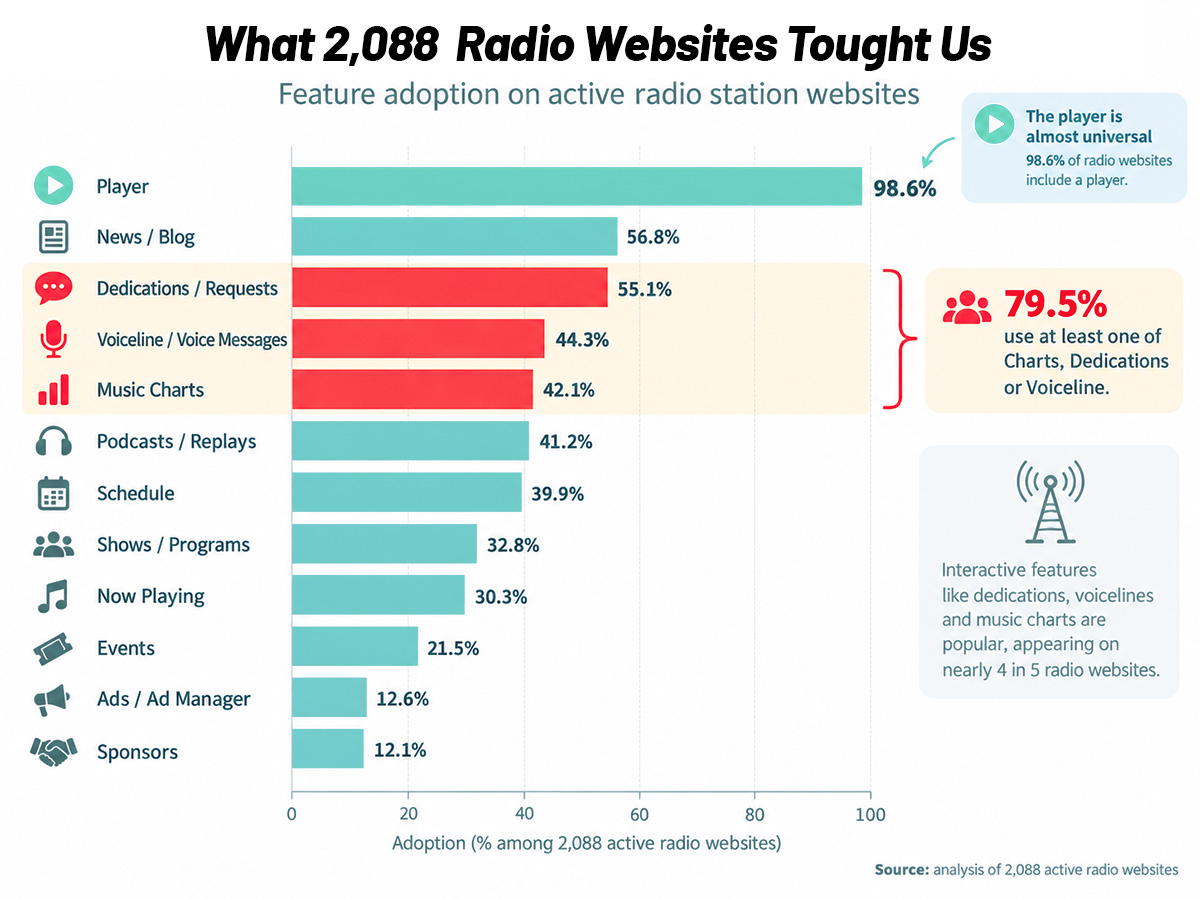
Here are some of the most common features detected in the study:
- Player: 2,059 websites — 98.6%
- News / Blog: 1,187 websites — 56.8%
- Dedications / Requests: 1,151 websites — 55.1%
- Voiceline / Voice Messages: 925 websites — 44.3%
- Music Charts: 879 websites — 42.1%
- Podcasts / Replays: 860 websites — 41.2%
- Schedule: 833 websites — 39.9%
- Shows / Programs: 685 websites — 32.8%
- Now Playing: 632 websites — 30.3%
There are several different types of radio website represented here. Some stations concentrate heavily on news, others on programming, podcasts or music.
But interaction appears remarkably high in the list.
Dedications and requests were found on more than half of the websites we analysed, while voice messages appeared on more than four out of ten.
For something that can easily be considered an “extra” when planning a website, that is a significant level of adoption.
So what is this tool?
Requests, voice messages, music charts, podcasts, schedules and other features that give listeners something to do beyond simply pressing Play are extremely common.
In particular, 70.4% of the websites we analysed used either Dedications or Voiceline, while 79.5% used at least one of Music Charts, Dedications or Voiceline.
That makes listener participation one of the clearest patterns in the data.
Almost 8 out of 10 sites use at least one listener interaction feature
Individual feature percentages are useful, but grouping related features makes the pattern easier to see.
79.5% of the websites used at least one of Music Charts, Dedications or Voiceline.
If we narrow the definition specifically to the two features that allow listeners to send something directly to the station, 70.4% used either Dedications or Voiceline.
By comparison, 58.4% used at least one of Schedule, Shows or Now Playing.
This does not mean that interaction is “more important” than a schedule, a show page or information about what is currently on air. Adoption data cannot tell us that.
What it does tell us is that listener participation is not a niche use case among the Pro Radio websites we studied. It is a very common part of how stations are using their websites.
There is also an important limitation to keep in mind: our scanner is primarily homepage-oriented. Features that normally live on internal pages can therefore be undercounted.
Even with that limitation, the interaction figures are high.
Why interaction fits radio so naturally
Radio has never really been a one-way medium.
Long before station websites existed, listeners were already calling presenters, requesting songs, sending dedications, entering competitions and voting in charts.
The website gives those familiar behaviours another place to happen.
Consider two listeners.
- One visits the station website, presses Play and listens to the broadcast.
- Another does the same thing, but later votes for a song, sends a dedication to a friend or records a message for the presenter.
The second listener has done something more than consume the stream. They have contributed to the station.
That does not automatically mean they will listen longer or become a more loyal listener — our study did not measure that. But from the station’s point of view, the relationship is clearly different. The website is no longer only delivering information and audio; it is also providing a way for the audience to participate.
That is particularly relevant to radio because participation has always been part of the medium.
Three common ways to add listener participation
The interaction does not need to be complicated, and a radio website does not need to become another social network.
In most cases, the useful interactions are closely connected to something the station is already doing on air.
Within Pro Radio, three types appear particularly relevant to this pattern.
1. Song requests and dedications
Requests are one of the oldest forms of radio interaction.
A listener asks for a favourite song, sends a birthday message or dedicates a track to somebody else. The station can then bring that contribution back into the programme.
Pro Radio Dedications moves that process onto the station website.
Listeners can submit requests and messages online, while the station retains control over what is accepted and used.
In our dataset, Dedications and Requests appeared on 1,151 of the 2,088 websites analysed, or 55.1%.
That makes it one of the most frequently detected features in the entire study.
2. Listener voice messages
Voice messages take the same idea a little further.
With Voiceline, listeners can record a message directly from the website and send it to the station.
A presenter might ask a question during a programme and invite listeners to respond. Stations can also use voice messages for greetings, reactions, competitions, opinions or shout-outs.
The contribution can then become part of the programme itself.
We detected Voiceline or another identifiable voice-message implementation on 925 websites, representing 44.3% of the dataset.
More importantly, when Dedications and Voiceline are considered together, 70.4% of the websites used at least one of them.
That suggests that direct listener-to-station communication is a substantial part of how Pro Radio customers are using their websites.
3. Music charts, voting and song discovery
Music stations have another source of interactive content available to them: the songs they already broadcast.
A recently played song can become something a listener discovers, revisits or votes for. Over time, those interactions can also feed into charts and rankings.
Music Charts appeared on 879 websites in the study, or 42.1%.
Pro Radio Sidekick extends this area by using the station’s song information for features such as recently played music, song history and other music-driven website content.
Depending on how the station wants to use that data, this can support things such as:
- listener-voted charts
- weekly Top 10 rankings
- song likes and voting
- recently played tracks
- music discovery pages
This is particularly useful because the source material already exists: the station is playing the music anyway. The website can reuse that information instead of requiring somebody to manually create every piece of music content.
Do you have Pro Radio WP or Pro Radio Plus? This is good news.
Those tools are present for free in your software, just drag a widget on your homepage, and the feature is in place!
Only if you want more, like automations or email notifications, maybe you want to switch to the premium plugin versions, or Ai charts generator, or automatic MP3 conversions of the voice messages (Voiceline can upload mp3 files of the voice messages to your radio streaming via FTP!). Otherwise, the basic version ships by default with the theme. And it’s included in many demos like this or this.
What does this look like on a real radio website?
Interaction does not necessarily require a special section dominating the entire website. In many cases it works best when it sits naturally alongside the player, programming and station content.
Several Pro Radio demos show different ways of doing this.
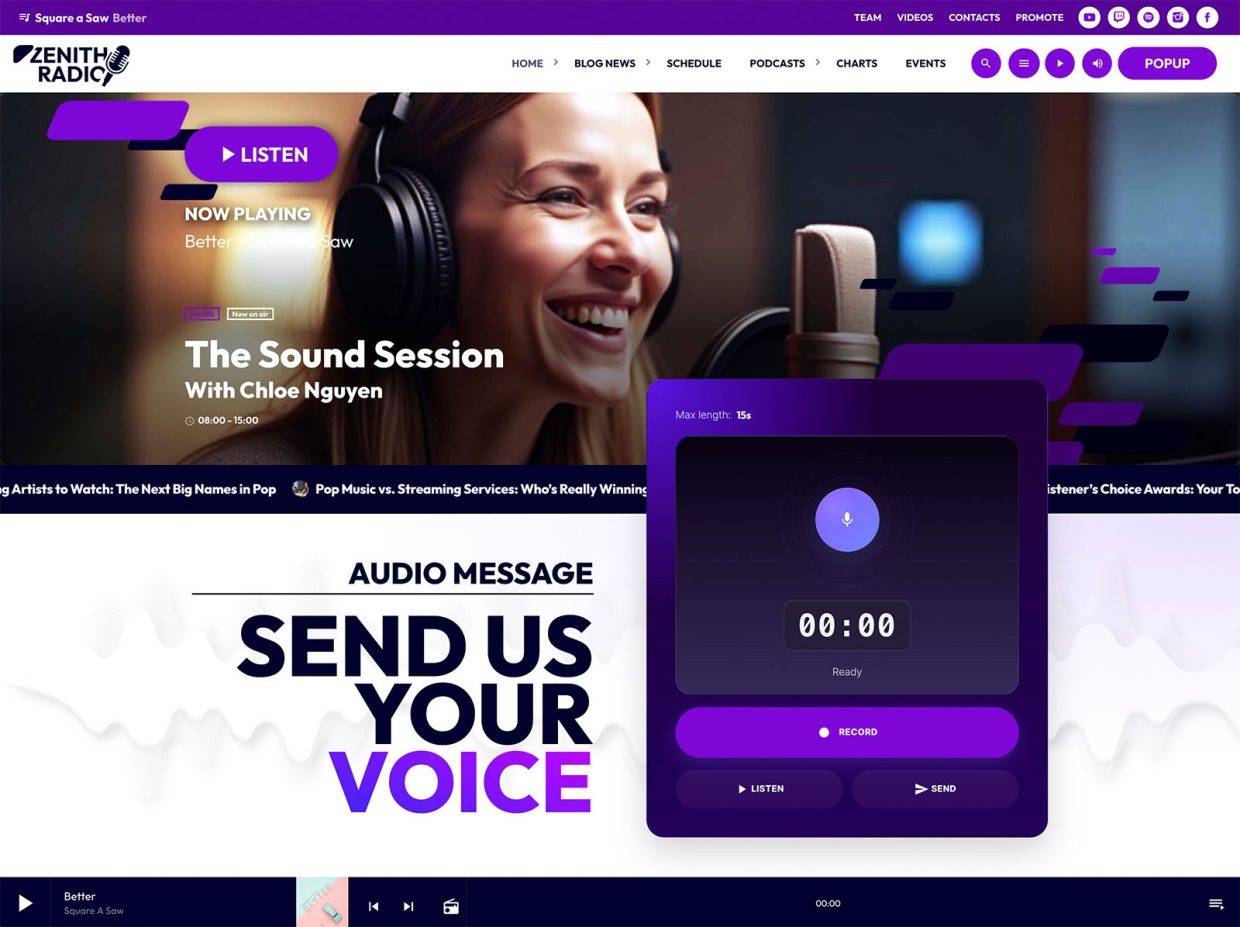
PopTop Radio — interaction around the music
PopTop Radio is a clear example of a music-focused approach.
It combines Sidekick with music charts, song voting and Dedications, allowing the listener to move from listening to the station into discovering and interacting with its music.
The important point is that these are not isolated tools. They all relate directly to what the station is already broadcasting.
Zenith Radio — listener voices on the homepage
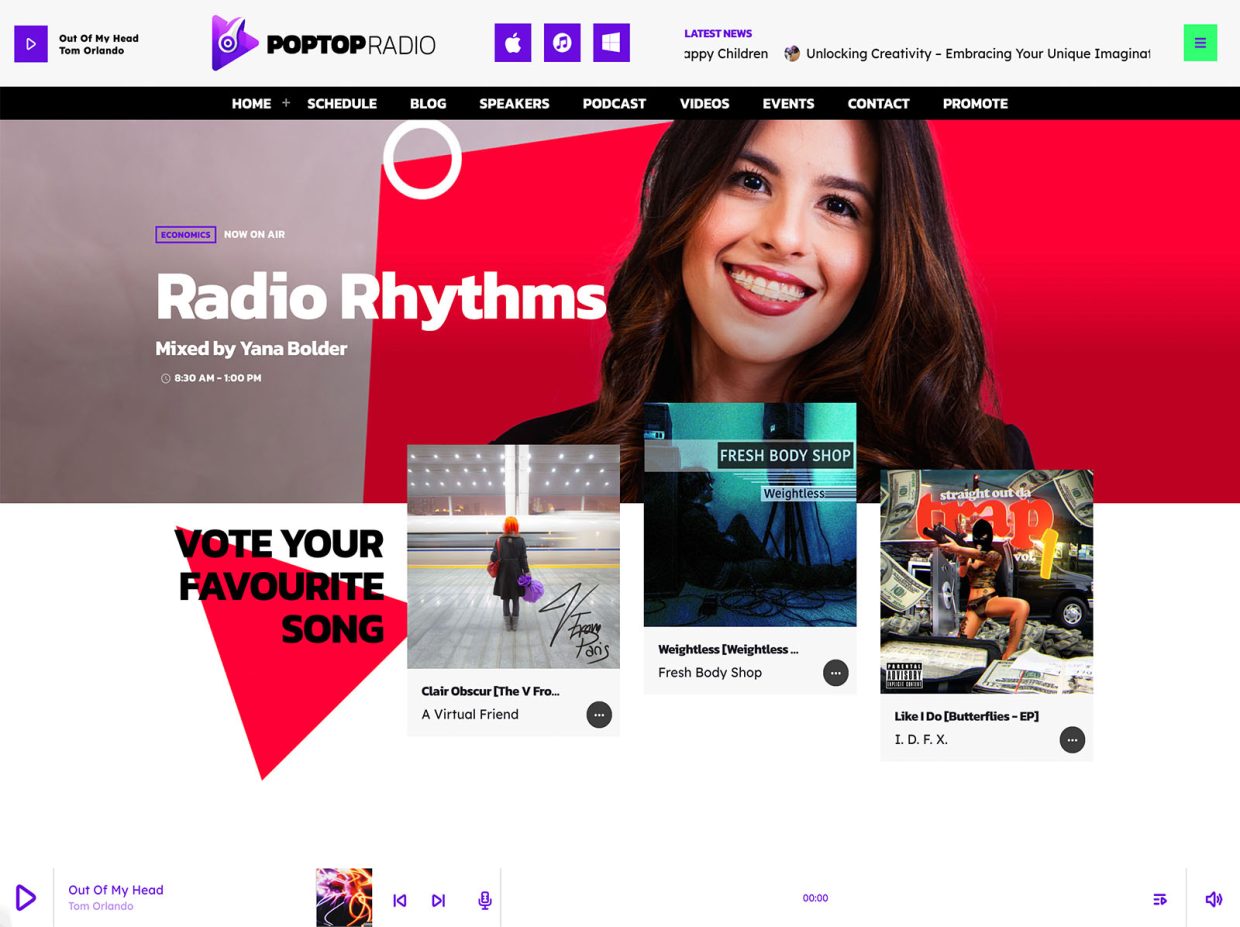
Zenith Radio takes a different approach.
Alongside the player, current show, schedule, news and podcasts, it places Voiceline directly on the homepage.
The interaction is therefore presented as a normal part of the station experience rather than something hidden on a separate contact page.
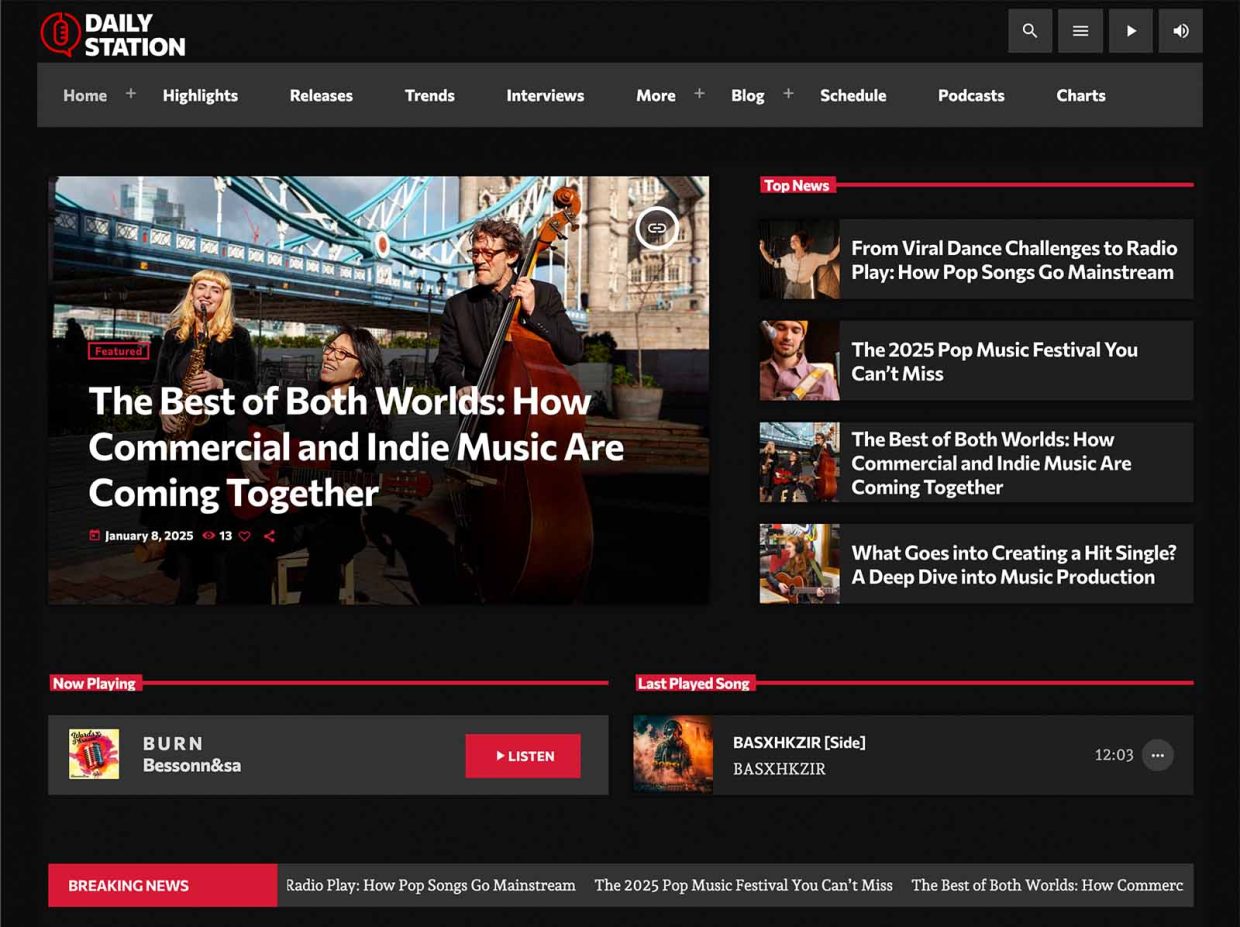
Daily Station — music rankings as regular content
Daily Station shows how voting and music charts can become part of the normal homepage structure.
One of its layouts combines information about the programme currently on air with song voting and chart sections.
This turns music interaction into regular station content rather than treating it as a separate feature.
Blue City Radio — requests alongside traditional station content
Blue City Radio integrates Dedications alongside more traditional radio website elements such as the player, podcasts, presenters and events.
It is a good example of how a station can add one clear form of listener participation without rebuilding the whole website around interaction.
From “What content should we publish?” to “What can listeners do?”
When planning a radio website, most of the first questions are naturally about content.
- We need a player.
- We need the schedule.
- We need presenter pages.
- We need shows, podcasts, news and events.
Those are all reasonable priorities, and the data shows that many stations use them.
But our study suggests that there is another useful question to ask at the same time:
What can listeners actually do on the website?
- Can they request a song?
- Can they vote?
- Can they send something to the presenter?
- Can they record a message?
Can their contribution eventually become part of the programme?
For radio, these are not unusual online behaviours invented by websites. They are digital versions of things listeners have been doing with radio stations for decades.
You do not need every interaction at once
The data should not be interpreted as a checklist requiring every station to install every available feature. Different formats have different needs.
A request-driven music station may get more practical value from Dedications. A talk or community station may find voice messages particularly useful. A music-focused station may prefer charts, voting and song discovery.
Then mention it on air. Give people a reason to use it. See whether it becomes part of the normal relationship between the programme and its audience.
The most obvious result of our study was that the player remains fundamental: it appeared on 98.6% of the 2,088 active Pro Radio websites analysed.
But the more interesting result was what surrounded it.
The conclusion of the study
70.4% used Dedications or Voiceline, and 79.5% used at least one of Music Charts, Dedications or Voiceline.
The data does not tell us that these features directly cause stronger engagement, longer listening sessions or better station performance. That would require a different type of study.
But what we can say with confidence is that the radio stations that have been using Pro Radio for the longest are all actively displaying listener-feedback tools on their homepages. This suggests a correlation between long-term station success and the ability to collect listener feedback, messages, music votes and recommendations.
The rest of the website can give them a way to take part.


You may also like



Copyright 2019-2026 ProRadio® Qantum Themes SL® ESB02979078 All Rights Reserved